
Culture in Djibouti: languages, heritage and crafts
Djiboutian culture is a crossroads: two main communities, Afar and Somali, sit alongside a Yemeni, Indian and French legacy. French and Arabic are the official languages, while Somali and Afar structure daily life. That mixing shows in the food, the coral architecture of Tadjourah, the markets of Djibouti City and a craft tradition of weaving and incense that is still alive. Rock art heritage, meanwhile, goes back several millennia.
| Updated on | 16 September 2026 |
|---|
Why is Djiboutian culture best understood through its crossroads?
Djibouti occupies a position few countries can claim: at the mouth of the Bab el-Mandeb strait, on the sea route linking the Red Sea to the Indian Ocean, between the Horn of Africa and the Arabian peninsula. That position produced a culture of mixing rather than of synthesis: traditions did not merge, they layered.
Two main communities, Afar and Somali, form the base. To that are added an old Yemeni legacy, a trading Indian presence, and a century of French protectorate whose language and architecture still carry its mark.
The consequence for the traveller is pleasant: within a few days you move from a coral house to an incense market, from a spiced rice dish to a pastry inherited from the Levant, without ever leaving the same region.
Which languages do you hear, and in what context?
French and Arabic are the official languages. Administration, higher education and part of the press work in French, which makes the trip easy for a French-speaking visitor.
Daily life, however, runs in Somali and Afar. Those are the two languages you hear in the market, in taxis and in the camps inland. English remains little used outside hotels and tourism providers.
In practice, a few words of French open almost every door, and gesture does the rest. In the camps of the Forêt du Day, Djalélo or Assamo, you are often welcomed in French or Afar, with local guides interpreting.
Which physical heritage can you actually see?
Three groups can be visited, and they cover very different scales of time.
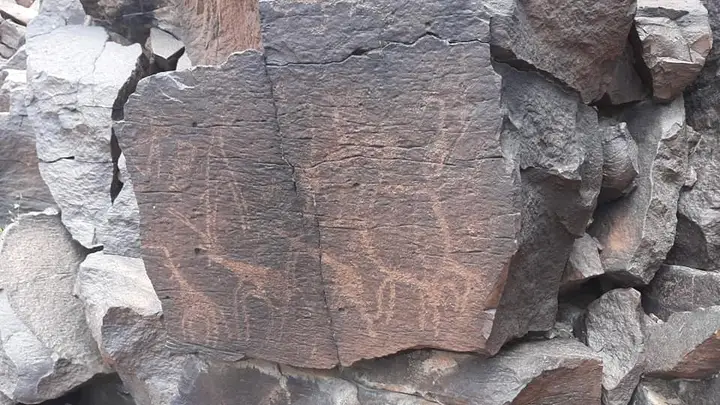
Rock art. Grand Bara displays engravings dated from 3000 to 2000 BCE, showing elephants, oryx and giraffes — evidence of a far wetter climate then. The Abourma site unfolds almost three kilometres of pastoral and hunting scenes carved into basalt, to be seen during the cool season.
Architecture. Tadjourah the white owes its name to its coral stone buildings. In Djibouti City, the colonial district around place du 27-Juin and the Al-Hamoudi mosque, built in 1906, keep their houses with wooden balconies.
Industrial and archaeological heritage. The Holl Holl viaduct, opened in 1900 on the Djibouti–Addis Ababa railway, and the Handoga site, occupied from the Middle Ages to the pre-Islamic period, complete the list for anyone interested in the long view.
What do people eat, and what does the food say about that mixing?
Djiboutian cooking borrows from four traditions: Somali, Afar, Yemeni and French, with a marked Indian contribution. It rests on goat and camel meat, Red Sea fish, rice, fermented flatbreads and Middle Eastern spices.
Skoudehkaris, spiced rice with meat, is the national dish. Fah-fah, a spiced meat broth, is eaten late in the evening. Lahoh and sabayad flatbreads structure breakfast, and samboussa are sold at any hour.
The page Djiboutian cuisine details the dishes, the produce and the price ranges, with the central market as the starting point.
What should you bring back, and where to buy it?
Local crafts are organised around three product families.
Weaving holds the central place: boukra and scarf lengths are found in the markets and the shops of the capital. Salt, worked or smoked, is a souvenir directly linked to the sites visited, even if you must resist the temptation to take some on site. Incense and spices from the central market are easy to bring back and travel well.
One point of care, which is as much about respect as about the law: taking salt, gypsum or crystals in quantity from Lake Assal or Lake Abbe is an offence. Those sites are protected natural heritage.
How do you make contact with local communities?
The best way in remains accommodation. The country’s camps and ecolodges are often run by local associations: two of them, Djalélo and Assamo, return their revenue to the protected areas. Sleeping there is a direct contribution to conservation.
The second way in is the guide. For the Forêt du Day, the Dittilou cirque, Abourma or the Seven Brothers archipelago, a local guide is strongly recommended: off-track navigation, protected areas subject to permit, and no waymarking. The camps provide trained guides.
Finally, festivals and markets offer less supervised contact. Place Mahamoud-Harbi and its market, in Djibouti City, concentrate most of the trading life.
Where to go next?
This hub deliberately contains only one detailed thematic page so far: Djiboutian cuisine. Others will follow — crafts, music, rock art heritage — and will appear here.
To place culture within a stay, cross this page with the overview what to see in Djibouti and the destination pages. Questions of timing and kit are covered in the practical pages, and water activities in the experiences.
Culture
Browse Djibouti's craft productsSecure booking, verified provider.
Frequently asked questions
Which languages are spoken in Djibouti?
French and Arabic are the two official languages, and both administration and higher education work largely in French. In the street and at home, Somali and Afar dominate, depending on the community. English remains little used outside the tourism and hotel sector. A few words of French or Arabic are almost always enough to start a conversation.
What can you bring back from a trip to Djibouti?
Local crafts revolve around three families. Weaving (boukra and scarf lengths) holds a central place. Salt, worked or smoked, is a souvenir directly linked to the sites visited. Finally, incense and spices from the central market are easy to bring back. Do not, however, take salt, gypsum or crystals from protected sites: that is an offence.
What historical heritage can you see in Djibouti?
Three groups stand out. Rock art first, with the Grand Bara engravings dated from 3000 to 2000 BCE and those of Abourma, which unfold pastoral and hunting scenes on basalt. Then Tadjourah, with its coral stone architecture. And Djibouti City, whose colonial district, the Al-Hamoudi mosque of 1906 and the Holl Holl viaduct, opened in 1900, keep the trace of the protectorate.
How do you discover Djiboutian culture on the ground?
The central market of Djibouti City remains the best starting point: spices, incense, fabrics and daily life all concentrate there. The old town, around the Al-Hamoudi mosque, keeps its houses with wooden balconies. To go further, the ecotourism camps inland offer direct contact with Afar communities and their pastoral traditions. Allow a day for the essentials.