Buses and taxis in Djibouti: fares by zone and route
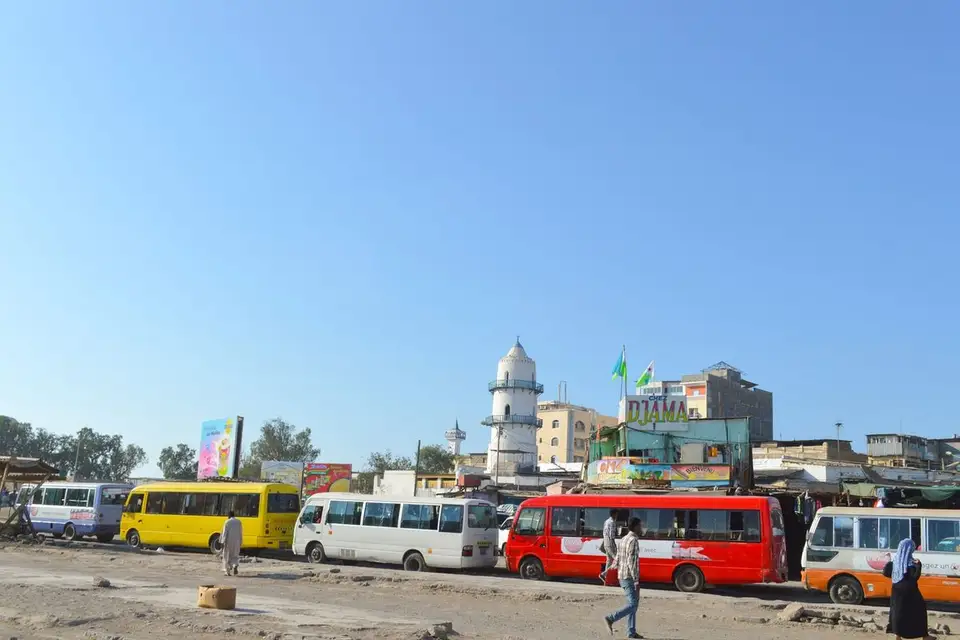
In Djibouti, taxis have no meter: they charge by zone, at 600 Djiboutian francs a ride in the capital. Between Ambouli airport and the city centre, the National Tourism Agency publishes a single figure, about 1,500 Fdj. Minibuses start at about 50 Fdj per zone, and regional buses cost from 500 Fdj to Arta up to 2,000 Fdj to Obock, on the agency's January 2021 grid.
What this page publishes. The fares below come from the National Tourism Agency’s grid dated 21 January 2021, available at ant.dj/infos-utiles: taxis and minibuses charged by zone, and regional buses to Tadjourah, Obock, Dikhil, Ali-Sabieh and Arta. We do not convert those fares into a price per kilometre — the official grid does not work that way — and we do not reproduce the ranges found in third-party guides as if they were an official fare. In Djibouti, the price of a ride is agreed before you get in.
What is the price of a taxi in Djibouti?
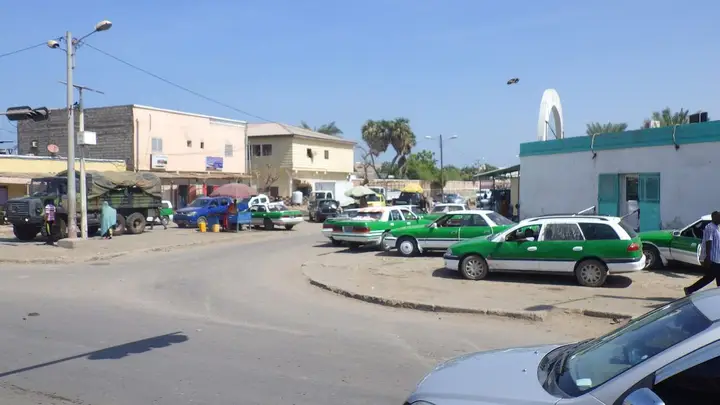
In Djibouti City a taxi is not paid by the meter: there is none. The fare is counted by zone, and the reference amount published by the National Tourism Agency is 600 Djiboutian francs (Fdj) per zone.
Two practical consequences. First, the price is asked before you get in: state your exact destination, have the number of zones confirmed, then get in. Second, bring change: getting change back is never guaranteed, and a 5,000 Fdj note for a 600 Fdj ride is badly received.
Part of the fleet runs as a shared taxi: several passengers on the same axis, one price per person, and a departure that waits until the car is full. It is the cheapest way to travel in the capital, and the slowest.
| Journey | Mode | Published reference fare | Good to know |
|---|---|---|---|
| Ride within the capital | Taxi | 600 Fdj per zone | Agency fare, to be confirmed before getting in |
| Ambouli airport ↔ city centre | Taxi | About 1,500 Fdj | A single value published by the agency, not a range |
| Urban journey along one axis | Minibus or bus | From about 50 Fdj per zone | Leaves when full, with no fixed timetable |
| Djibouti City → Tadjourah | Regional bus | 1,500 Fdj | Departs behind the UNFD premises |
| Djibouti City → Obock | Regional bus | 2,000 Fdj | Departure point not stated by the grid |
| Djibouti City → Dikhil | Regional bus | 700 Fdj | Departs from the Balbala livestock market |
| Djibouti City → Ali-Sabieh | Regional bus | 600 Fdj | Departs from the Balbala livestock market |
| Djibouti City → Arta | Regional bus | 500 Fdj | Departs from the Balbala livestock market |
| Ambouli airport ↔ city centre | Public shuttle | Service not documented | No regular shuttle is attested |
| Site outside the capital | Vehicle with driver | On quotation | The only realistic option for the interior |
Those regional buses really do appear in the grid published by the agency, dated 21 January 2021: they are official fares, not estimates.
How does the zone fare work?
The capital is divided into zones, and the price of a ride matches the number of zones crossed. A journey contained entirely within one zone therefore costs 600 Fdj; a journey crossing two is paid twice that amount.
The system has one merit: it is stable, known to everyone, and depends neither on traffic nor on a device. It has one flaw: it cannot be checked anywhere, so it rests on a verbal agreement. Two habits are enough to avoid the argument.
- Give a starting point and an end point, not “the city centre”. It is the number of zones crossed that sets the price, and the driver estimates it from your actual route.
- Keep small notes in Djiboutian francs. It is the only currency reliably accepted in transport.
How much is a taxi from the airport to the city centre?
Ambouli international airport stands about seven kilometres from the city centre, roughly a ten-minute drive. For that journey, the agency publishes a single value: “allow about 1,500 DJF”, taken from its January 2021 grid. It is not a range: the 1,000 Fdj floor circulating in several guides is not published by the agency, and we do not attribute it to them.
It is not displayed on an official sign at the terminal exit: agree the price with the driver before loading the luggage, and politely decline if the figure quoted goes well beyond that amount. Third-party sites announce amounts of up to 4,000 Fdj: we do not reproduce that figure as a reference, but it circulates, and it is better to know that before landing. In practice, a ride negotiated below 1,500 Fdj remains possible: the market decides, not a displayed grid.
No regular public shuttle links the airport to the city centre. Hotels sometimes arrange a transfer: ask for it when booking, which is often the simplest solution after a night flight.
What is the price of a taxi for 10 km?
There is no fare per kilometre in Djibouti. Neither by meter nor by kilometre driven: the agency’s official grid charges by zone, and no scale by distance is published. The question, which is widely searched, therefore has no honest figure as an answer — and we would rather write that than invent a scale.
What matters is the number of zones crossed. In Djibouti City, most useful journeys — accommodation, market, port, corniche — stay short and are settled in one or two zones. Ten kilometres, on the other hand, means crossing the whole built-up area: expect several zones, and a price agreed before departure.
How much is a minibus or a city bus?
Minibuses and city buses form the capital’s public transport network, from about 50 Fdj per zone. It is the cheapest mode, and it runs on filling up: the vehicle leaves when it is full, with no published timetable.
Three things to know before getting on. The signing of the routes is informal: you spot them by the axis they follow rather than by a displayed number. Bulky luggage is awkward on board. And the stop is asked for: you announce your destination to the driver or to a neighbour on the bench.
For a traveller the interest is twofold: the cost, and the real life of the city. The downside is time — a minibus waiting to fill up can turn a twenty minute journey into an hour.
How do you reach Tadjourah and the other towns by bus?
Regional buses do not leave from a single central bus station: the departure points depend on the direction. Those serving the northern coast, towards Tadjourah, leave the capital behind the UNFD premises — it is the only northern-coast departure the grid specifies. Those heading south — Dikhil, Ali-Sabieh, Arta — leave from the Balbala livestock market. For Obock, the grid publishes the fare without stating the departure point: the question is settled on the spot.
Contrary to what we previously wrote, the agency does publish the fares for those links. Here is its grid, dated 21 January 2021 and available at ant.dj/infos-utiles.
| Destination | Published fare (agency grid, January 2021) | Departure point |
|---|---|---|
| Tadjourah | 1,500 Fdj | Behind the UNFD premises |
| Obock | 2,000 Fdj | Not stated by the grid |
| Dikhil | 700 Fdj | Balbala livestock market |
| Ali-Sabieh | 600 Fdj | Balbala livestock market |
| Arta | 500 Fdj | Balbala livestock market |
A 2021 grid is not this year’s price: those amounts are the last official fare published, and it is confirmed on departure, with the driver or at the counter. Bring the exact money in cash, and leave early: these vehicles fill up before they go.
For the northern coast, the bus is not the only option. The ferry to Tadjourah and Obock crosses the gulf and replaces a long road journey with a sea crossing. Compare according to your programme: the boat saves time, the bus serves more places along the way.
For sites in the interior — Lake Assal, Lake Abbé, Abourma — the regional bus is not a realistic option. Those sites are visited with a vehicle and a driver, either as part of an organised excursion or as a hire.
Is Djibouti safe?
The official British advice, published by the FCDO and updated on 27 July 2026, mentions a risk of petty crime and recommends three precautions: do not walk alone late at night, and keep valuables out of sight — cameras and passports in particular. That advice holds inside a taxi too: do not leave your passport in the boot of a car you are leaving.
The same document reports a terrorist threat and explicitly lists transport hubs among the places liable to be targeted, alongside hotels, restaurants and shopping areas. It is a regional assessment, not an opinion specific to Djibouti City: stay aware of your surroundings and follow the instructions of the local authorities.
In practice, carry a copy of your passport separately from the original, and tell your accommodation about any travel outside the capital.
Is the cost of living high in Djibouti?
Third-party comparison sites estimate the Djiboutian cost of living at about thirty per cent above that of France, with a travel budget of about 127 euros per person per day on the spot, excluding the international flight. Those are comparison-site estimates, not official data, and we present them as such.
The average salary often comes up in the same searches. We do not publish it: it is national statistics, and INSTAD is the source to consult. A transport fare can only be read correctly against that yardstick: 600 Fdj represent a very different share of a budget depending on income.
How much should you budget for a day of travel?
A day of sightseeing in the capital is budgeted from the documented fares alone, without assuming any tip or surcharge.
| Item | Basis of calculation | Estimate for the day |
|---|---|---|
| Two taxi rides in town | 600 Fdj per zone | About 1,200 Fdj |
| Three minibus journeys | About 50 Fdj per zone | About 150 Fdj |
| Transfer to or from Ambouli | About 1,500 Fdj (agency value) | About 1,500 Fdj |
| A day outside the capital | On quotation | Not documented |
An airport transfer therefore weighs more, on its own, than a whole day of taxis in town: it is the item worth negotiating, or worth asking your accommodation to arrange.
How do you pay for your journeys?
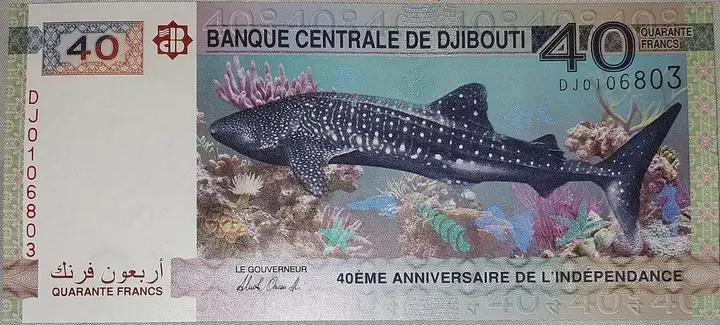
In cash, in Djiboutian francs. Taxis and minibuses do not take cards, and mobile payment is not a reliable fallback for a passing traveller. Bring small notes before going out.
If your first expense is the transfer from the airport, change a small amount on arrival: there is a bureau de change inside the Ambouli terminal. For what is settled as soon as you cross the border, see our page on visa and entry formalities.
Should you hire a vehicle with a driver?
As soon as you leave the capital, yes. The city taxi does not serve Lake Assal, Lake Abbé or the Forêt du Day, and those sites lie at the end of tracks that are not tackled with an ordinary car. Two options exist: car hire in Djibouti if you drive yourself, and a vehicle with a driver, which is more common for touring.
The choice depends above all on the number of days. On a day trip, the driver is simpler and often cheaper than a hire, fuel and insurance included. Over a week with several stops, hire regains the advantage. In both cases, leave early: heat and light decide what you can see. Our page on when to go to Djibouti details the seasons, and the one on weather and climate gives the temperatures site by site.
Frequently asked questions
What is the price of a taxi in Djibouti?
The reference fare published by the National Tourism Agency is 600 Djiboutian francs per zone in the capital. A ride that crosses two zones is therefore paid twice that amount. There is no meter: the price is agreed before you get in. Bring change, because getting change back is never guaranteed.
What is the price of a taxi for 10 km?
The official grid charges by zone, never by distance: no per-kilometre scale is published in Djibouti. The calculation is therefore made by zones crossed. Ten kilometres in the capital means crossing the whole built-up area, so several zones. Agree the price before you get in, announcing your actual route.
Is Djibouti safe?
The official British FCDO advice reports a risk of petty crime and recommends not walking alone late at night, and keeping valuables, passports and cameras included, out of sight. The same document mentions a terrorist threat targeting transport hubs in particular. That advice holds inside a taxi too.
Is the cost of living high in Djibouti?
Third-party estimates put the cost of living about thirty per cent above that of France, with a travel budget of about 127 euros per person per day on the spot, excluding the international flight. Those figures are comparison-site estimates, not official data. The average salary belongs to national statistics, where INSTAD is the source to consult: we do not reproduce it here, for want of a quotable figure.
How much does a train ticket from Djibouti to Dire Dawa cost?
That fare is published by the National Tourism Agency: 1,600 Djiboutian francs for a Djiboutian national, 800 for a foreigner, on the January 2021 grid, to be confirmed at the station. The ticket is bought the day before, at the western salt works in front of the ABDAN laboratory or at Nagad. Departure is on even days at 8:00 am, with arrival at Nagad two hours before.
Sources
Practical
Read next
4×4 with a driver in Djibouti: prices and itineraries
Accessibility in Djibouti: what a demanding trip implies
Boat hire in Djibouti: trips out to sea
Budget in Djibouti: what does a trip cost on the spot?
Car hire in Djibouti: 4×4, saloon or driver?
Connectivity and SIM cards in Djibouti: internet and mobile
Djibouti airport transfer: taxi, fares and arrival
Djibouti–Addis Ababa train: line, tickets and station