Culture and heritage: rock art and old cities in four days
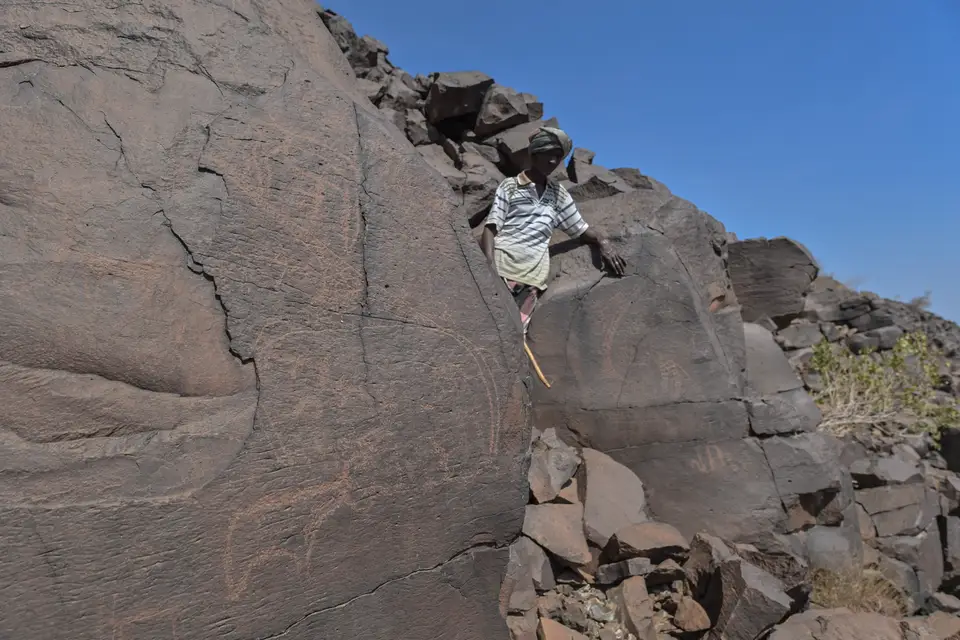
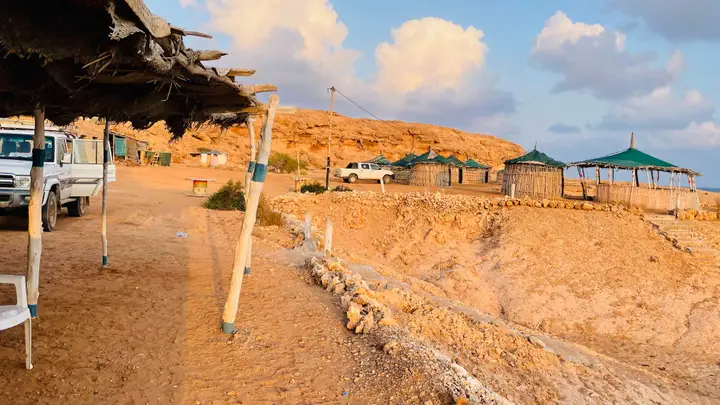
This 4-day and 3-night itinerary organises Djiboutian heritage in two blocks: the north first, with Tadjourah, the Abourma engravings and the rock art of Balho, then the south, with Daasbiyo, its cave, its paintings and its tumuli. It begins and ends in Djibouti City, whose historic centre occupies the first day.
Why is the heritage of Djibouti visited in two blocks?
Because the sites are spread across the two ends of the country, and they do not obey the same access rules. The north is covered on tarmac road, with a final walk on foot for Abourma. The south is reached by the Ali-Sabieh axis, of which the village of Daasbiyo is about fifteen kilometres away.
The geographical split has a second merit: it separates two natures of heritage. In the north, rock art — engravings cut into basalt, across three sites of which two share the same chronological horizon. In the south, a funerary and village group: a cave, paintings, tumuli, and a medieval town still inhabited.
Between the two, the first day is spent in the historic centre of Djibouti City. It is the only place in the programme visited entirely on foot, and the only one documenting the country’s colonial history — a useful counterpoint before going to look at engravings several millennia old.
We include the north and the south, and deliberately leave out one site: the pre-Islamic village of Handoga, in the Gobaad basin, which belongs to the Lake Abbe journey and not to this one. The reason is in the last chapter of this page.
What is the programme, day by day?
| Day | Stages | What is published on access | Meals | Overnight |
|---|---|---|---|---|
| Day 1 — Djibouti City | Historic centre on foot: place du 27-Juin, place Mahamoud-Harbi and its market, Rue des Mouches, Al-Hamoudi mosque (1906), Ambouli gardens | No journey: the town is covered on foot, preferably in the morning | Local lunch in town | Djibouti City |
| Day 2 — the north and Abourma | Djibouti City → Tadjourah → Randa → final walk on foot from Giba Gebiley to the engraved panels | The site is not served by road: vehicle to the sector, then an accompanied walk | Picnic taken along: no visitor facility, no ticket, no water point | Tadjourah |
| Day 3 — Balho and the border | Tadjourah → national highway 11, fully tarmac and inaugurated in November 2019 → Dorra → Balho, about thirty kilometres west of Dorra | RN11 is a freight axis: plan for water and fuel, and do not photograph the checkpoints | Meals taken along or a stop at Dorra | Tadjourah |
| Day 4 — the south | Return south → Ali-Sabieh region → Daasbiyo: the cave, its paintings, the tumuli around, the village station and well | About 62 km south-east of Djibouti City, about fifteen kilometres north-east of Ali-Sabieh; local accompaniment necessary | Lunch on the southern axis | — |
Day 2 is the densest, and deliberately so: Abourma is earned on foot, and a serious visit takes time. The engravings line up over nearly three kilometres of cliffs west of a wadi, and the published documentation records about 930 panels. You will not see 930: you will see the most legible groups, and that is already a great deal.
Day 3 is the most uncertain, for a reason that has nothing to do with heritage: Balho is a border post, the third official crossing point between Djibouti and Ethiopia since 20 September 2020. Carry an identity document, even if you do not cross the border, and refrain from photographing the checkpoints.
What can you see at each of those sites?
| Site | Region | What is documented | Access |
|---|---|---|---|
| Historic centre of Djibouti City | Djibouti | Place du 27-Juin and its Moorish arcades, place Mahamoud-Harbi, Rue des Mouches, the Al-Hamoudi mosque of 1906 able to hold about 1,000 worshippers, the Ambouli gardens, the Eega memorial and its 14.5 km electrified barrage | On foot, in the morning |
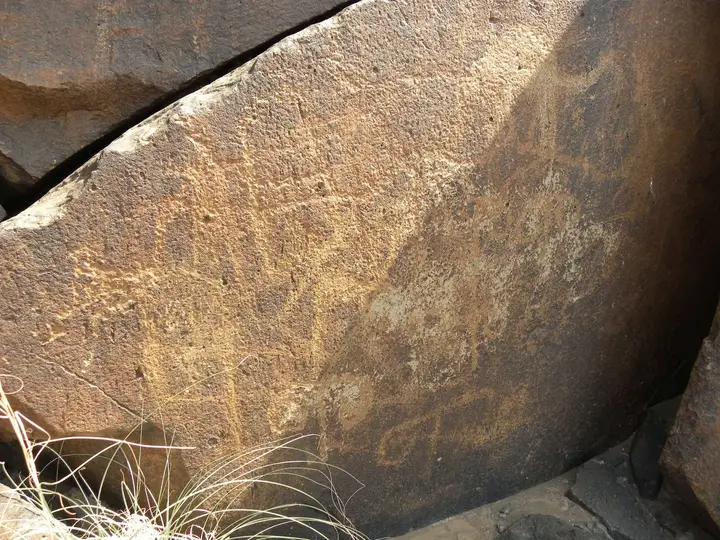
| Abourma rock engravings | Tadjourah, Makarrassou massif | Engravings on basalt boulders: human figures in action, wild and domestic animals, hunting and combat scenes; nearly 3 km of cliffs, about 930 panels recorded | On foot from Giba Gebiley, north of Randa, with a local guide |
| Rock art of Balho | Tadjourah, national highway 11 | A site attached by archaeologists to the period of the first cattle herders, the oldest horizon of rock art in the Horn of Africa; in 1974, the paintings served as a motif for stamps | Via RN11; no museum, no marked trail, no ticket |
| Daasbiyo cave | Ali-Sabieh | Described by the National Tourism Agency as the shelter where the site’s first occupants kept their equipment; the national press mentions its rock paintings, without publishing their number, motifs or dating | From Ali-Sabieh or from Djibouti City; no ticket or timetable documented |
| Daasbiyo tumuli | Ali-Sabieh | Tumuli known locally as awellos: basalt blocks forming a circle, flat and circular on the plain, pyramidal in the mountains; according to the official source consulted, about 3000 BCE | On the village territory, with a companion |
A clarification on the datings, because it holds for this whole chapter. For Balho, the sources do not agree: Wikipedia attributes about 10,000 years to the paintings, while the TRACES laboratory attaches the site to the period of the first cattle herders, which it places nearly five thousand years ago. The two markers differ by a factor of two. We publish both, with their origin, rather than choosing one.
How much does a four-day cultural itinerary cost?
We have to start with a disclaimer: no entry rate is published for Abourma, Balho or Daasbiyo, because none exists. These are not developed sites: you do not buy a ticket there, you organise a visit.
| Item | Published amount | Origin of the offer |
|---|---|---|
| Forêt du Day package, Tadjourah region — 1 person | 87,220 Fdj per person | day-forest-package |
| Forêt du Day package — 2 people | 62,300 Fdj per person | day-forest-package |
| Forêt du Day package — 3 people | 51,620 Fdj per person | day-forest-package |
| Forêt du Day package — 4 people | 44,500 Fdj per person | day-forest-package |
| Forêt du Day package — 5 to 10 people | 35,600 Fdj per person | day-forest-package |
| Hire of a 4×4 with driver | ≈ 44,000 Fdj per vehicle per day | Rate published on the Lake Assal page |
| Eega memorial entry | 1,000 Fdj for a foreign visitor; 500 Fdj for an adult; 200 Fdj for a pupil or student | Rate published on the Djibouti City page |
| Visit to Abourma, Balho or Daasbiyo | No rate published | No catalogue offer concerns those sites |
| Organised two-day formula, city and Lake Assal | 15,130 Fdj, and 35,000 Fdj for the second announced formula | massigo-two-day-djibouti-city-and-lake-assal-tour and circuit-2jours-ville-lac-assal |
Two methodological remarks.
The Forêt du Day package is cited as a regional marker, not as a programme. It is the only published offer organising a day in the Tadjourah region, that of Abourma and Balho. Its heading concerns the forest and the Goda mountains, not the rock art sites: we cite it because it gives the order of magnitude of a supervised day in that sector, and it is for the operator to say what it would accept adding.
We do not add those lines up. A 4×4 billed by the day, a package billed per person and entries per unit do not usefully total, and the number of vehicle days depends on the operator. The only figure we own is the vehicle rate, because it is published as it stands.
A word, finally, on the two city and Lake Assal formulas: they show 15,130 and 35,000 Djiboutian francs for an identical announced programme. We flag that gap without explaining it, and we invite you to ask for a written quotation before paying a deposit.
How is a rock art site actually visited?
Like a hike in an arid environment, not like a museum. The catalogue mentions no visitor facility at the Abourma site: no ticketing, no water point, no shade. For Daasbiyo, the sources consulted document neither ticket, nor timetable, nor appointed guide.
| What to plan for | Why |
|---|---|
| Three litres of water per person at minimum | No supply point documented on the sites |
| Closed, high-cut shoes | Sharp basalt boulders, unstable ground |
| Hat, glasses and sun protection | No natural shade along the route |
| A local guide | The panels are not marked, and the tumuli blend into the ground |
| Cash | Electronic payment is very limited outside the capital |
| A margin of time | A visit that drags on that terrain ends badly |
Four rules of conduct hold for the three sites, and none is a matter of principle.
Do not touch the engraved rock. Friction erases the contrast between the patina and the line.
Do not wet or rub the panels to make them stand out in a photograph: it is the gesture that damages an engraving fastest.
Take nothing away. Neither a chip of rock, nor sherds, nor beads, nor tumulus stones: the country’s awellos are already looted, and a stone carried off is a stone lost to research.
Ask before photographing. At Daasbiyo, you are not in a deserted site but in an inhabited village: ask the inhabitants’ agreement, and refrain in front of official installations.
The details of each site are on our pages for the Abourma engravings, the Daasbiyo cave and Balho.
What is left aside, and why?
Three exclusions, owned.
Handoga. The pre-Islamic village of the Gobaad basin, about fifteen kilometres west of Dikhil, is one of the country’s most interesting archaeological sites: ceramics, glass-paste beads and a Chinese coin were found there, the first unearthed in an archaeological context in the Horn of Africa. But it lies on the Lake Abbe axis, and going there from Tadjourah then back south within the same day would turn the day into a journey. Handoga belongs to the Lake Abbe trip, not to this one.
The Grand Bara engravings. They are dated 3000 to 2000 BCE and more accessible than those of Abourma, on the southern axis. They would make a coherent fifth day, not an extra fourth stage.
A long stop at Tadjourah. The white town fills day 2 in transit only. Its coral-stone buildings, its Fiaa and Cheick Mohamed beaches and its hinterland deserve a day of their own: the Tadjourah page gives the markers.
What the programme does contain, on the other hand, cannot be compensated for: the three rock art and funerary sites form a coherent chronological whole, from the oldest to the most recent. Adding a fourth without adding a day would amount to seeing three badly.
What do you eat on the road?
The table is part of the heritage, and it costs nothing to include: the programme’s stages all pass through towns where people eat locally.
In Djibouti City, day 1 naturally ends with a neighbourhood meal. Skoudehkaris, spiced rice cooked with meat and lifted with cumin, cardamom and cinnamon, is regularly cited as the national dish. Fah-fah, a goat stew-soup simmered with potatoes, cabbage, leeks, tomato and green chilli, is eaten with a flatbread for dipping. Lahoh and sabayad structure breakfast, and spiced tea — shaah, infused with cardamom, cinnamon and ginger — is drunk at any hour. The detail of the dishes, the places and the customs is on our page on Djiboutian food.
For days 2 and 3, on the other hand, count on yourself: no supplies are documented on the rock art sites or on the Balho axis, and national highway 11 was designed for freight, not for stops. Take a picnic and water from Tadjourah or the capital.
One last disclaimer: we publish no price list for Djiboutian dishes, because no public one exists. The only documented marker in our data is an included meal, the beach day with lunch at Khor-Ambado, from 4,000 Djiboutian francs per adult. For the rest, the prices are read on the spot. Before leaving, also check the seasonal window: walking on black rock without shade is nothing like the same in January and in June, and the recommended season for the rock art sites runs from October to February.
Frequently asked questions
How many rock art sites can you see in four days?
Three, two of them in the north of the country. Abourma, on the Makarrassou massif, lines up engravings over nearly three kilometres of basalt boulders. Balho, on national highway 11, belongs to the same ancient horizon, that of the first cattle herders. Daasbiyo, in the south, holds a cave with rock paintings and a group of tumuli. The Abourma visit is made on foot.
Do you need a guide to visit Abourma?
Yes, it is the practical condition of the visit. The panels are scattered over several kilometres of boulders that look alike, and nothing on site marks or explains them. A local guide leads you to the most legible groups and helps distinguish the figures. He also recalls the rules: do not touch the rock, do not wet it, take nothing away.
Does the catalogue sell an excursion to those sites?
No. No offer in the booking catalogue concerns Abourma, Balho or Daasbiyo. Those visits are organised with a vehicle and local accompaniment, and the rate is requested directly. The catalogue also offers no guided visit of the historic centre of Djibouti City: it is covered on foot, over half a day.
How much does a four-day cultural itinerary cost?
No rate is published for entry to Abourma, Balho or Daasbiyo: the visit is organised, it is not bought at a ticket office. The only published markers are logistical: about 44,000 Djiboutian francs for a 4×4 with driver per day, and 15,130 to 35,000 francs for an organised two-day city and Lake Assal formula. Eega memorial entry is 1,000 francs for a foreign visitor.
What can you see in the historic centre of Djibouti City?
Place du 27-Juin, formerly place Ménélik, and its Moorish arcades; place Mahamoud-Harbi, its open-air market and the Rue des Mouches; the Al-Hamoudi mosque, built in 1906 and still active; the Ambouli gardens, irrigated by underground channels; and the Eega memorial, recalling the 14.5-kilometre electrified barrage that divided the capital from 1967 to 1977.
Sources
Itineraries
Read next
Budget in Djibouti: backpacker, mid-range, luxury
Desert and lakes: salt, rift and Lake Abbe in four days
Diving in Djibouti: the three-day itinerary
Djibouti and Ethiopia: combining the two countries
Djibouti in 1 day: the rift or the beach?
Djibouti in 10 days: the assembly of three itineraries
Djibouti in 2 days: the rift, the salt and the sea
Djibouti in 2 weeks: what the second week adds