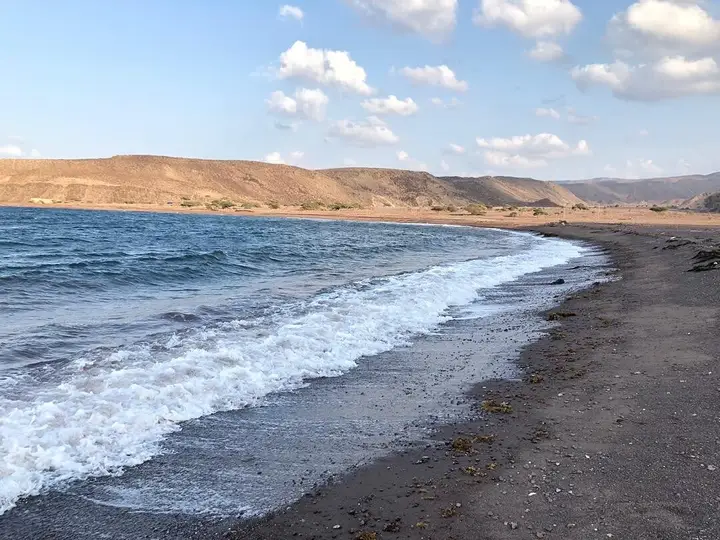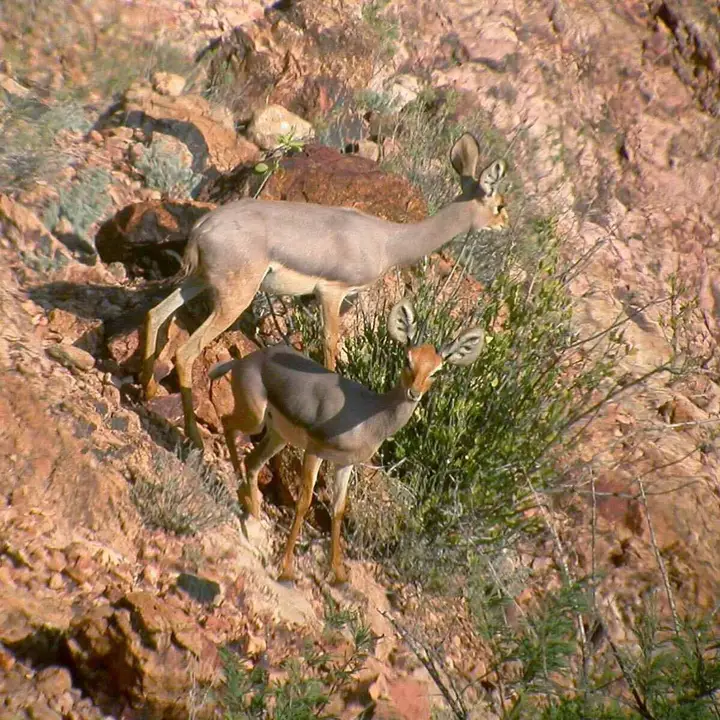
Lake Abbe: the limestone chimneys of the Gobaad
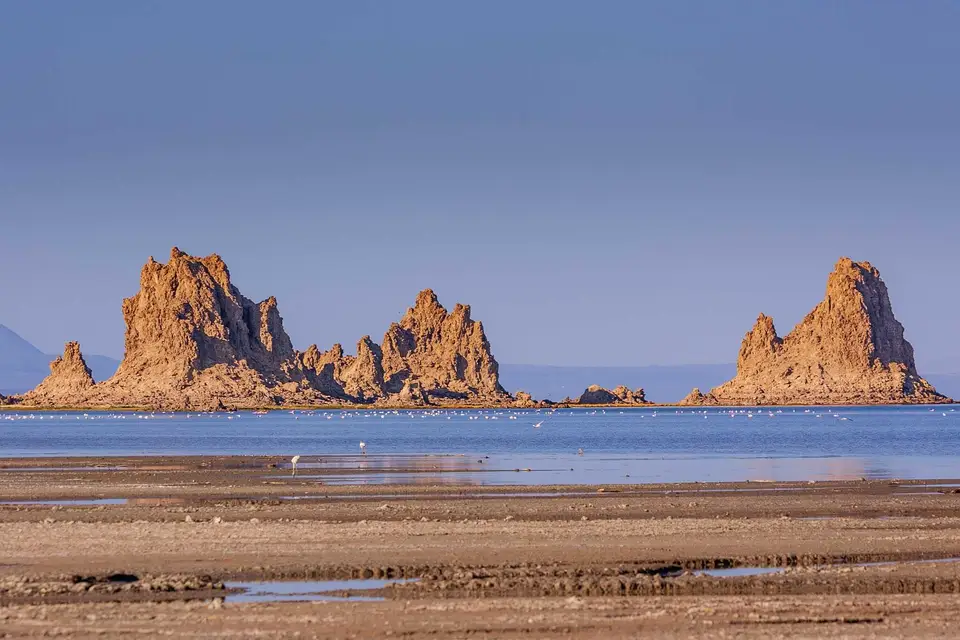
Lake Abbe lies in the Dikhil region, straddling the Ethiopian border, at the bottom of the Gobaad depression. This endorheic salt lake is no more than 8.6 metres deep and has been receding sharply since the 1950s. Its silhouette is unique: crystallised limestone chimneys 30 to 50 metres high, born from springs that have since dried out. The visit is made by 4×4, with a bivouac on site.
Where is Lake Abbe?
Lake Abbe occupies the floor of a graben framed by two horsts, in the Gobaad depression, west of the Dikhil region. Its body of water straddles the border with Ethiopia: it is a cross-border lake, and the visit is made from the Djiboutian shore.
It is an endorheic salt lake, meaning it has no outlet to the sea. The water that reaches it leaves only by evaporation, which concentrates the salts and explains the extreme mineral content of the environment. The local name, Abhe Bad, means “rotten lake”, referring to the sulphur emissions rising from the springs.
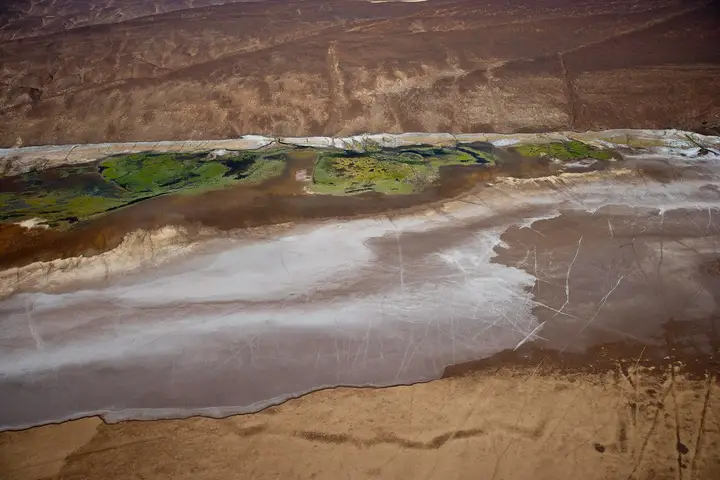
About 8,500 years ago, this lake covered most of the Gobaad depression, near Dikhil, over an area estimated at 6,000 km². What you see today is therefore only the remnant of a far larger expanse: the chimneys that made its reputation were then submerged. Understanding that changes how you read the landscape — you are walking on an ancient lake bed.
Key facts
| Reference | Data |
|---|---|
| Administrative region | Dikhil |
| Coordinates | 11.166 N — 41.854 E |
| Nature of the site | Endorheic salt lake of tectonic origin |
| Status | Terrestrial protected area |
| Depth | 8.6 m — a shallow lake |
| Height of the chimneys | 30 to 50 m |
| Border | straddles Ethiopia |
| Access | track, 4×4 essential |
| Recommended duration | 2 to 3 days, with a night on site |
| Best season | November to February |
How do you get to Lake Abbe?
Access is by track, in a 4×4, with a driver who knows the area. No ordinary touring vehicle ventures there: the sand, the wadi crossings and the absence of landmarks make it a route that needs preparing.
The journey from Djibouti City takes up a large part of the day. That is exactly why the packages offered at booking run over two or three days rather than a day trip: you drive, you arrive for late afternoon, you bivouac, and you leave in the morning.
Three practical consequences follow from that distance:
- Travel with a vehicle and a guide. The site being both a border area and protected, accompaniment is not a luxury but the norm.
- Carry your own water and food. There is no organised supply on site.
- Allow a margin. On track, a breakdown or a bogging down translates immediately into lost hours.
What is there to do at Lake Abbe?
Watch the chimneys at dawn and dusk
That is when the site takes on its full dimension. The low light lifts the columns from the ground and reveals the texture of the limestone. In the middle of the day, the crushing light flattens the relief and the chimneys lose their depth.
Understand the geology on site
The chimneys are not ordinary concretions. Gypsum-laden water, crossing the lake’s sodium-carbonate waters at high temperature, reached supersaturation: the fumaroles mineralised, forming sulphurous steam vents turned to stone. The site reads like an open-air geological cross-section, and that is what earns it scientific interest as much as scenic appeal.
Walk on the former lake bed
The plain around the chimneys is an exposed lake floor. You walk there on evaporite deposits, in a landscape of salts and dried muds that the wind reshapes. Stay on your guide’s tracks: some areas keep a fragile crust with loose ground beneath.
Meet herders and their livestock
The site remains grazing territory. Traditional and small-scale herding is permitted and supervised there: it is not rare to meet herds being driven to water points. It is a dimension of the place that is often left unmentioned, and it explains the fragile balance of the environment.
Push on to the neighbouring sites
The Gobaad basin is not only geological. About fifteen kilometres west of Dikhil, the archaeological site of Handoga overlooks the Chekheitti wadi: pottery, glass-paste beads and a Chinese coin have been found there, the first unearthed in an archaeological context in the Horn of Africa. The pre-Islamic village served as a relay between the ancient port of Zeila and the interior.
Is Lake Abbe shrinking?
Yes, and that is an established fact. The lake has been receding and drying up spectacularly since the 1950s. Two causes combine: natural phenomena linked to how the arid depression works, and human actions, notably upstream water use.
That retreat is precisely what makes the chimneys visible. They were built at the bottom of the lake, around springs that have now dried up, then the water body withdrew and left them in the open air. In other words, the landscape you photograph is the product of a hydrological retreat: it is a site in motion, not a fixed postcard.
How much does a visit to Lake Abbe cost?
Rates depend on group size, because the main cost is the vehicle and its driver, not the number of passengers.
| Package | Indicative price | Pace |
|---|---|---|
| Lake Abbeh package — 5 to 10 people | from 53,000 Fdj / person | On quotation |
| Lake Abbeh package — 4 people | 75,650 Fdj / person | On quotation |
| Lake Abbeh package — 1 person | 133,500 Fdj / person | On quotation |
| Two-day tour: Lake Abbe and Lake Assal | 55,000 Fdj | 2 days |
| Three-day tour: Lake Abbe, Tadjourah, Les Sables Blancs | 85,000 Fdj | 3 days |
| Three-day tour: Lake Abbe, Tadjourah and Lake Assal | 44,500 Fdj | 3 days |
The logic is simple: the larger the group, the more the cost of the 4×4 is diluted. Travelling as a single passenger is expensive; with ten people the price per head becomes comparable to a coastal excursion.
When to go to Lake Abbe?
| Period | Felt heat | State of the track | Nights | Recommendation |
|---|---|---|---|---|
| November – February | Moderate | Firm | Cool | Ideal window |
| March – April | Rising | Correct | Mild | Acceptable |
| May | Strong | Deteriorating | Hot | Not advised |
| June – August | Very strong | Difficult | Stifling | To be avoided |
| September | Strong | Difficult | Hot | To be avoided |
| October – December | Falling | Correct | Bearable | Good window |
The cool season is not only more pleasant: it makes the track firmer, the nights bearable and the days practically longer, because you can walk without stopping every hour.
What should you know before setting off?
- Water is the first logistical item. Carry far more than your estimated consumption: the site offers no supply point.
- Protect yourself from sun and wind. Hat, sunglasses, long sleeves and sun cream, even in the cool season.
- Do not taste the water or touch the deposits with bare hands in the spring areas: the mineral content is aggressive.
- Tell someone your itinerary. The area is isolated and phone coverage is not continuous.
- Carry cash. No card payment is conceivable on site.
- Bring a head torch: at the bivouac, night falls quickly and there is no lighting.
How do you visit Lake Abbe responsibly?
The site is a terrestrial protected area. The state has established a list of protected species and hunting there is strictly forbidden. Traditional herding and ecotourism are permitted, but regulated and monitored.
In practice, four gestures are enough:
- Travel with a local guide and follow their route instructions.
- Take no salt, crystals or fragments of chimney. The limestone is friable: a sample damages the structure irreversibly.
- Carry all your waste back, including organic. The site has no collection.
- Keep your distance from herds and herders’ camps.
Finally, bear in mind that the value of the place goes beyond the spectacle. Lake Abbe carries the trace of great stages in the history of the planet as well as of people: an ancient lake of 6,000 km², fossilised hydrothermal springs, ancient human occupation in the same basin. It is that bundle of evidence, more than the chimneys themselves, that justifies protecting the site.
Preparing your trip
To settle dates and logistics, compare the published packages: two- to three-day stays leave time for the bivouac, while combined tours add Lake Assal or Tadjourah on the same route. If you are coming from Ethiopia or heading back to Addis Ababa, check entry formalities in advance on the official visa portal and the state of the access roads with your operator.
Frequently asked questions
What are the limestone chimneys of Lake Abbe?
They are former hydrothermal springs that once lay beneath the lake surface. Meeting the sodium-carbonate waters, gypsum-rich seepages caused mineral supersaturation: limestone crystallised around the vents and formed columns. As the lake withdrew, those chimneys now reach 30 to 50 metres and stand in the open air, like natural monuments.
Can you visit Lake Abbe as a day trip?
No, a single day is not enough under reasonable conditions. The track is long, partly sandy, and crosses an arid environment with no supplies. The packages offered at booking run over two or three days, with a night on site or nearby. That is also what lets you arrive for the evening and morning light, when the chimneys stand out best.
What is the best period to visit Lake Abbe?
From November to February. The Gobaad depression is among the hottest areas in the country: in summer, the heat makes the track gruelling and the bivouac uncomfortable. In the cool season, nights stay bearable and the low morning light catches the chimneys sideways. March and April mark an acceptable transition, before the temperature climbs.
Is Lake Abbe a protected site?
Yes. Lake Abbe is listed as a terrestrial protected area. The state has established a list of species under special protection and hunting there is strictly forbidden. Traditional and small-scale herding and ecotourism remain permitted, but are regulated and monitored. In practice that means you travel with a guide, take nothing, and carry all your waste back.
Sources
Location
Lat. 11.16582Lng. 41.85424
Destinations
Read next
Abourma: the rock engravings of the Makarrassou massif
Ali-Sabieh: the south-east region, sites and camps
Allols depression: salt, hot springs and caravans
Ardoukoba: the most recent volcano in Djibouti
Arta: the cool of the interior and whale sharks
Assamo: the protected area of the beira antelope
Balho: rock art and the northern border post
Bankoualé: the oasis at the foot of the Goda massif