Forêt du Day: the last great forest massif in Djibouti
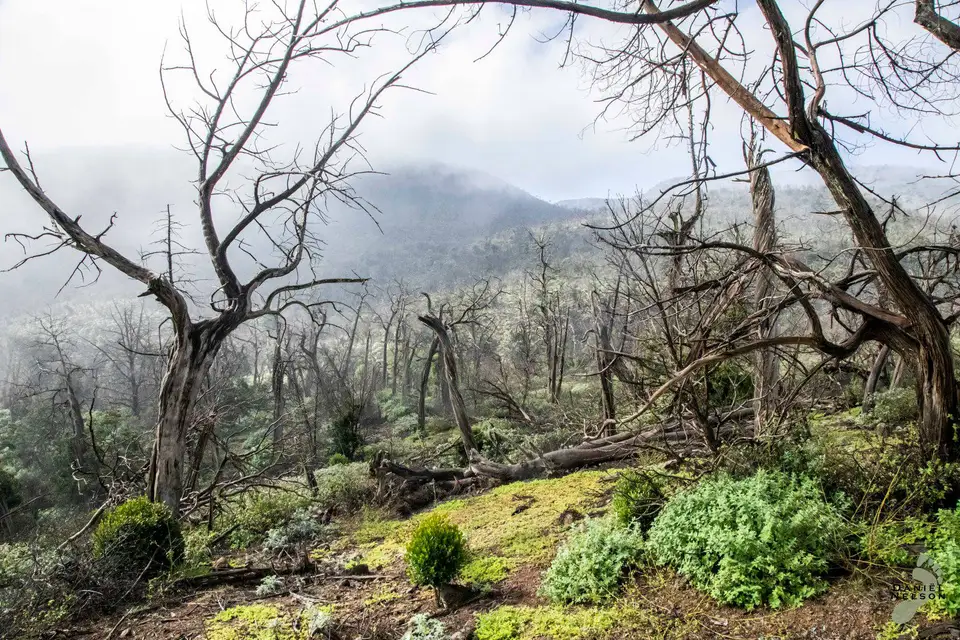
The Forêt du Day is the main forest massif in Djibouti: a protected area of 30 square kilometres, west of the Gulf of Tadjoura, in the Tadjourah region. It occupies the Goda massif, whose summit peaks at 1,799 metres at Bara'barré, and holds almost all the wooded areas in the country. It shelters the Djibouti francolin, the country's only endemic bird, today gravely threatened.
A relict forest, not a tropical one. The Forêt du Day is not a remnant of jungle: it is an island of high-altitude vegetation, surviving in an arid country because the relief holds moisture there. Its value comes precisely from its rarity — and its fragility comes from the same place.
What is the Forêt du Day?
The Forêt du Day is a protected natural area in central Djibouti, and the country’s main wooded group. The catalogue presents it as the place that “gathers all the wooded areas of the Republic of Djibouti”; the park certainly concentrates most of the national forest stands.
It has an old administrative history. The article on the park reports that a national park of Daï was created by an order of 6 January 1939, that it then served as a holiday spot for Europeans, and that guest lodges for tourists were built there in 1952, when a track made access easier. The surface area, however, has receded: from about 100 km² originally, it is 30 km² today.
The catalogue describes it as an oasis of greenery and coolness, accessible all year. The nuance comes down to one word: what decides access is not the site, it is the track. We come back to that below.
Where is the Forêt du Day?
The forest occupies the Goda massif, west of the Gulf of Tadjoura, in the Tadjourah region. The park’s high point stands at 1,782 metres, and the massif that carries it peaks slightly higher, at Bara’barré, at 1,799 metres, near the town of Day. That altitude explains everything else: it holds the clouds, slows evaporation and allows trees to survive in a country short of water.
| Reference | Data | Origin |
|---|---|---|
| Status | Protected natural area, national park since 1939 | Catalogue and article on the park |
| Surface | 30 km² (against about 100 km² originally) | Catalogue and article on the park |
| High point of the park | 1,782 m | Catalogue, Forêt du Day factsheet |
| Summit of the Goda massif | 1,799 m, at Bara’barré, near Day | Catalogue, Goda mountains factsheet |
| Limit of the stands | 950 m: above, junipers and olives; below, acacias and Terminalia | Catalogue and article on the park |
| Dominant species | Juniperus procera, Olea africana, Buxus hildebrandtii, Tarchonanthus camphoratus | Catalogue and article on the park |
| Emblematic bird | Djibouti francolin, endemic, critically endangered | Catalogue, article on the park, article on the francolin |
| Region | Tadjourah | Catalogue |
The massif is reached from Tadjourah or from the inland road. We publish no distance or journey time: they depend on the departure point and the state of the track. For logistics, see 4×4 rental with driver.
Which plants and animals are found there?
Four species dominate the canopy, according to both the catalogue and the article on the park: African juniper (Juniperus procera), African olive (Olea africana), boxwood (Buxus hildebrandtii) and Tarchonanthus camphoratus.
Distribution follows altitude. Above 950 metres, on the steep slopes, you find those four species. Below, where water accumulates more, boxwood remains but the group changes: Terminalia brownii and several species of the genus Acacia take over. That 950-metre limit is not a sharp boundary, it is a tendency.
On the wildlife side, the most notable species is the Djibouti francolin (Pternistis ochropectus), a ground bird of the pheasant family, about 35 centimetres long, endemic to the country. It is also what made the forest known: the species was described in 1952 from a specimen collected in the Forêt du Day. It is today classed as critically endangered, with a decline estimated at 90% of its population in twenty years, and is known from only two locations in Djibouti.
The forest also shelters other birds and small woodland wildlife, but it is the francolin that justifies most conservation efforts.
Why is the Forêt du Day under threat?
The problem is quantified. The article on the park estimates that 88% of the Day’s juniper forests have disappeared over the last two centuries, of which 20% in less than fifty years. In other words: the degradation is not old and stabilised, it has accelerated recently.
Three pressures combine. Grazing, which prevents regeneration by eating young shoots. Wood collection, for heating and building. And climate: in an already marginal environment, a run of dry years is enough to push the forest back.
Consequence for the visitor: this is not a backdrop. You walk on paths, you light no fire, you cut nothing, and you carry back everything you bring.
What can you visit on site?
The forest is walked. The catalogue mentions two concrete elements: the guest lodges built for tourists, a legacy of the period when the site served as a holiday spot, and the Bankoualé waterfall, described as flowing continuously. The view over the surrounding landscape, from the heights of the massif, is part of the programme.
It is a walking and watching site, not an attraction: no rides, no zip line, no shop. Bring closed shoes, water, and a layer for the end of the day — at nearly 1,800 metres, evenings do not resemble those on the coast.
When and how do you visit the Forêt du Day?
The catalogue says it is accessible all year, and announces no seasonal closure. Keep the nuance in mind: what decides is not the site, it is the track. Its state changes with the rains and with vehicle traffic, and access can become difficult without warning. Check the day before.
For the country’s general climate and the choice of season, our page when to go to Djibouti and the one on weather and climate give the useful reference points: altitude softens the heat, it does not remove it.
Two uses complement each other: the day trip from Tadjourah or the coast, and the one-night stay on site, which allows walking early in the morning and at the end of the day. To sleep in the area, see our page on camps and ecolodges.
How much does a visit to the Forêt du Day cost?
The Dalmar catalogue publishes a Forêt du Day package, whose rate per person decreases with group size.
| Group size | Published rate, per person |
|---|---|
| 1 person | 87,220 Fdj |
| 2 people | 62,300 Fdj |
| 3 people | 51,620 Fdj |
| 4 people | 44,500 Fdj |
| 5 to 10 people | 35,600 Fdj |
These figures are those of the published offer, taken as they stand from the catalogue. They cover the organisation of the trip; the exact content (transport, meals, guide, overnight stay) must be confirmed with the operator at the time of booking, because we do not detail it here.
Frequently asked questions
Can you visit the Forêt du Day all year?
The catalogue presents the forest as accessible all year, and announces no seasonal closure. The variable is the track: its state changes with the rains and with vehicle traffic, and access can become difficult without warning. Check with your operator or rental company the day before departure, rather than trusting a theoretical season.
What is the Djibouti francolin?
It is a ground bird of the pheasant family, about 35 centimetres long, endemic to Djibouti: it is found nowhere else. It is classed as critically endangered, after a decline estimated at 90% of its population in twenty years, and is known from only two locations in the country. Seeing one is far from automatic: the bird is very shy and lives in small groups among the junipers.
Which species are found in the Forêt du Day?
Four species dominate the canopy: African juniper (Juniperus procera), African olive (Olea africana), boxwood (Buxus hildebrandtii) and Tarchonanthus camphoratus. Distribution follows altitude. Above 950 metres, on the steep slopes, those four species; below, where water accumulates more, boxwood remains but the group changes, with Terminalia brownii and several acacia species.
Why is the Forêt du Day under threat?
Because its canopy is shrinking. The article on the park estimates that 88% of the Day's juniper forests have disappeared over the last two centuries, of which 20% in less than fifty years. The pressure comes from grazing, wood collection and climate change. Direct consequence: the Djibouti francolin, which depends on that habitat, is among the gravely threatened species.
How much does a visit to the Forêt du Day cost?
The Dalmar catalogue offers a Forêt du Day package whose rate per person falls with group size: 87,220 Fdj for a single person, 62,300 Fdj for two, 51,620 Fdj for three, 44,500 Fdj for four, and 35,600 Fdj per person for a group of five to ten. These figures are those of the published offer, transport and organisation included depending on the operator.
Sources
Location
Lat. 11.75595Lng. 42.68685
Destinations
Read next
Abourma: the rock engravings of the Makarrassou massif
Ali-Sabieh: the south-east region, sites and camps
Allols depression: salt, hot springs and caravans
Ardoukoba: the most recent volcano in Djibouti
Arta: the cool of the interior and whale sharks
Assamo: the protected area of the beira antelope
Balho: rock art and the northern border post
Bankoualé: the oasis at the foot of the Goda massif