Money and payments in Djibouti: Fdj, cards and cash
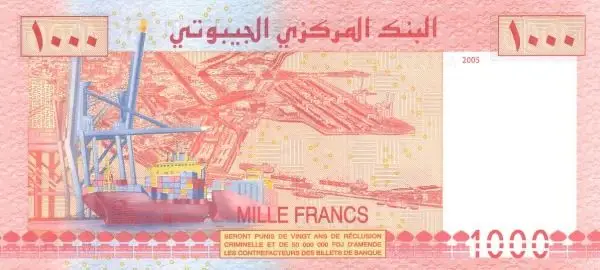
The currency of Djibouti is the Djiboutian franc, written Fdj and coded DJF, pegged to the US dollar at a fixed parity. Bank cards are little accepted on the spot and cash machines, present in Djibouti City, sometimes refuse Mastercard: plan for cash. The official e-Visa portal announces that it accepts Mastercard, Visa and American Express to pay for the visa online.
An honest page on a badly documented subject. On the means of payment accepted in Djibouti, our two internal sources contradict each other: the partner platform’s catalogue and its demonstration interface do not list the same mobile payment providers. We therefore publish neither list as a fact. What follows explicitly separates what is verified from what has to be verified on the spot.
What is the currency used in Djibouti?
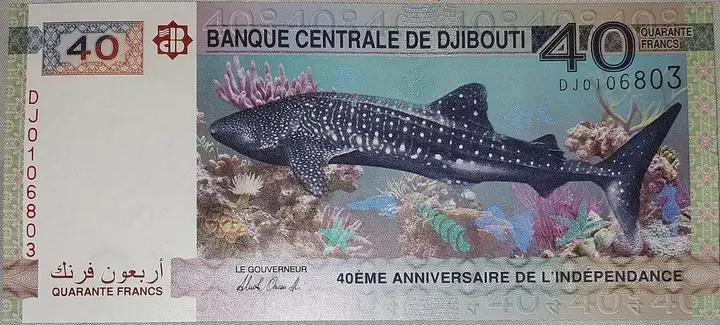
The national currency is the Djiboutian franc, written Fdj in local displays and DJF in international transactions.
| Characteristic | Value |
|---|---|
| Name | Djiboutian franc |
| Local symbol | Fdj |
| International code | DJF |
| Exchange regime | Pegged at fixed parity to the US dollar |
| Reference parity | 1 USD = 177.721 Fdj (fixed parity of the Central Bank of Djibouti, rounded to 177.7) |
| Monetary authority | Central Bank of Djibouti |
Two sources, two figures — and it is not a contradiction. The effective parity is that of the Central Bank of Djibouti: 177.721 francs to the dollar. The National Tourism Agency’s useful information page uses 177.5, which is a rounding and not another parity. We publish the central bank’s value, the one that actually applies to an exchange transaction, and we flag the agency’s rounding so that the gap between the two pages does not make you doubt both.
The dollar peg is the point to remember. It makes the Djiboutian franc stable and predictable for operators, but it has a consequence: the currency does not follow the euro. If the euro falls against the dollar, a stay costs more in euros, without the prices displayed in Djibouti having changed by a franc.
How much is 1 Djiboutian franc in euros?
We publish no conversion rate, and it is not an oversight. The Djiboutian franc being pegged to the dollar, its value in euros changes every day with the euro-dollar parity. A rate frozen in a web page would be wrong the following week — and that is exactly the kind of outdated information that loses a traveller’s trust.
Three useful rules instead:
- check the day’s rate with your bank, before departure, and not on a conversion site that does not display its update date;
- be wary of conversions at the counter without a display of the rate and the commissions: the real cost there is rarely visible;
- think in proportions, not in rates: a taxi in town from 600 Fdj, an excursion at about 18,000 Fdj, a night from 7,800 to 325,000 Fdj. Those orders of magnitude tell you whether a quoted price is reasonable, whatever the day’s rate.
What means of payment are accepted in Djibouti?
| Means of payment | Status | Where it works |
|---|---|---|
| Cash in Djiboutian francs | Verified — the most universally accepted | Everywhere: taxis, markets, camps, small shops |
| Cash in US dollars | Verified — accepted for the visa on arrival | Airport, certain tourist establishments |
| Bank card (often Visa) | Verified — little accepted, and rarely outside Djibouti City | International hotels, a few restaurants |
| Mastercard and American Express | Announced by the e-Visa portal, not verifiable at a distance | Online visa payment; local acceptance not guaranteed |
| Bank transfer | Declared by the partner platform | Remote bookings, not on the spot |
| Mobile payment | Not settled — see below | Depends on the provider and the sales point |
The official British advice is clear on this point: credit and debit cards are not widely accepted, and when they are, it is often a Visa card. It adds an explicit recommendation: make sure you carry enough cash.
Can you withdraw money on the spot?
Yes, in Djibouti City. The official British advice indicates that cash machines are normally available in Djibouti City, but that they may refuse Mastercard cards. Two practical consequences:
- carry two card networks if you can, rather than a single one, and check with your bank that withdrawals outside Europe are enabled;
- withdraw as soon as you arrive in town, without waiting until you need it in the interior of the country: outside Djibouti City, the density of cash machines becomes very low.
Also plan a cash reserve covering at least the transfer from the airport, which the National Tourism Agency’s grid places at around 1,500 Fdj (January 2021 grid, to be confirmed at the ticket office), and a day of excursion. Not every driver accepts cards.
Is mobile payment accepted in Djibouti?
This is the most delicate point of the page, and we would rather write it clearly than publish a flattering list.
Mobile payment exists in Djibouti and has developed with local financial services; several providers run by banks and by the incumbent operator are active on the market. We cannot, however, publish the list of accepted providers, for a simple reason: our two internal sources give lists that barely overlap. One cites mobile payment services backed by telecom operators, the other services backed by banks. Neither is reliably dated, and the gap between them has not been settled.
What that means for you, in practice:
- do not plan to depend on mobile payment to settle your stay or your excursions;
- ask your hotel or your operator, on arrival, which service it actually accepts — that is the only reliable information, because it is local and verifiable on the spot;
- keep cash as a fallback, including if you use a mobile wallet: an exhausted balance or a service outage cannot always be topped up on a Sunday.
We prefer that incomplete answer to a complete and false list: an error on this point is paid for at the moment of payment.
What does the official e-Visa portal accept?
Here, we report what the portal publishes, without claiming to have verified it ourselves. The official e-Visa portal of the Djiboutian government announces that it accepts, for settling the application online:
- Mastercard;
- Visa;
- American Express.
We cannot verify that list independently: the portal loads its content dynamically, and nothing allows it to be confirmed from a fixed document. We therefore report it as it is published, without a verification badge. On the day of payment, it is the portal’s screen that decides.
Payment is made during entry of the application, after filling in nationality and length of stay: that is when the rate is displayed, and nowhere else in a way that can be relied on. Note the important nuance: a card accepted by the online portal is not necessarily accepted by local payment terminals. They are two distinct networks, with two very different levels of acceptance.
If you opt for the visa issued on arrival, the official British advice states that it is paid in cash, in US dollars.
How should you manage your money during the stay?
- Carry cash in US dollars in addition to Djiboutian francs: it is the reference currency for the peg, and it is accepted where the euro is not.
- Change money in town, not at the airport, except for the first journey.
- Keep small notes: large notes are hard to change in small shops and camps.
- Split your cash between at least two places, and keep a digital copy of your documents in your mailbox.
- Keep your exchange and withdrawal receipts: they will serve you in case of a dispute with your bank on return.
What information does this page not publish?
We publish neither a fixed exchange rate, nor a list of mobile payment providers, nor a withdrawal limit, nor a commission amount. No source we can cite at the date of 11 September 2026 allows those points to be settled reliably. Consult the Central Bank of Djibouti for the monetary framework and the official British advice for daily practice.
Frequently asked questions
What is the currency in Djibouti?
The Djiboutian franc, whose symbol is Fdj and international code DJF. It is pegged to the US dollar at a fixed parity, of about 177.7 Djiboutian francs to the dollar: the Central Bank of Djibouti guarantees its convertibility. That peg explains the currency's stability, but also its sensitivity to the dollar rather than to the euro, which is nevertheless the reference currency for many European visitors.
How much is 1 DJF in euros?
We publish no fixed conversion rate, because none exists: the Djiboutian franc is pegged to the dollar, not to the euro, and its value in euros therefore moves day by day with the euro-dollar parity. Check the day's rate with your bank before leaving and refuse conversions offered at the counter without a clear display. Changing money at the airport almost always costs more than in town.
What are the means of payment in Djibouti?
Cash in Djiboutian francs remains the most universally accepted means of payment. The official British advice states that credit and debit cards are little accepted, and recommends carrying enough cash. Mobile payment exists in Djibouti, but the providers vary according to the operators and the sales points: check on the spot which ones are accepted by your hotel or your excursion operator.
Can you pay by bank card in Djibouti?
Rarely, and never everywhere. The official British advice indicates that credit and debit cards are little accepted, and that when they are, it is often a Visa card. It also notes that cash machines, normally available in Djibouti City, may refuse Mastercard. So withdraw your cash as soon as you arrive in town and always keep a reserve fund.
How do you pay for your e-Visa for Djibouti?
Online, by card, on the government's official e-Visa portal: the portal announces that it accepts Mastercard, Visa and American Express. The rate is displayed during entry of the application, once nationality and duration have been filled in. If you choose instead the visa issued on arrival, the official British advice states that it is paid in cash, in US dollars, at the airport.
Sources
Practical
Read next
4×4 with a driver in Djibouti: prices and itineraries
Accessibility in Djibouti: what a demanding trip implies
Boat hire in Djibouti: trips out to sea
Budget in Djibouti: what does a trip cost on the spot?
Buses and taxis in Djibouti: fares by zone and route
Car hire in Djibouti: 4×4, saloon or driver?
Connectivity and SIM cards in Djibouti: internet and mobile
Djibouti airport transfer: taxi, fares and arrival