Djibouti airport transfer: taxi, fares and arrival
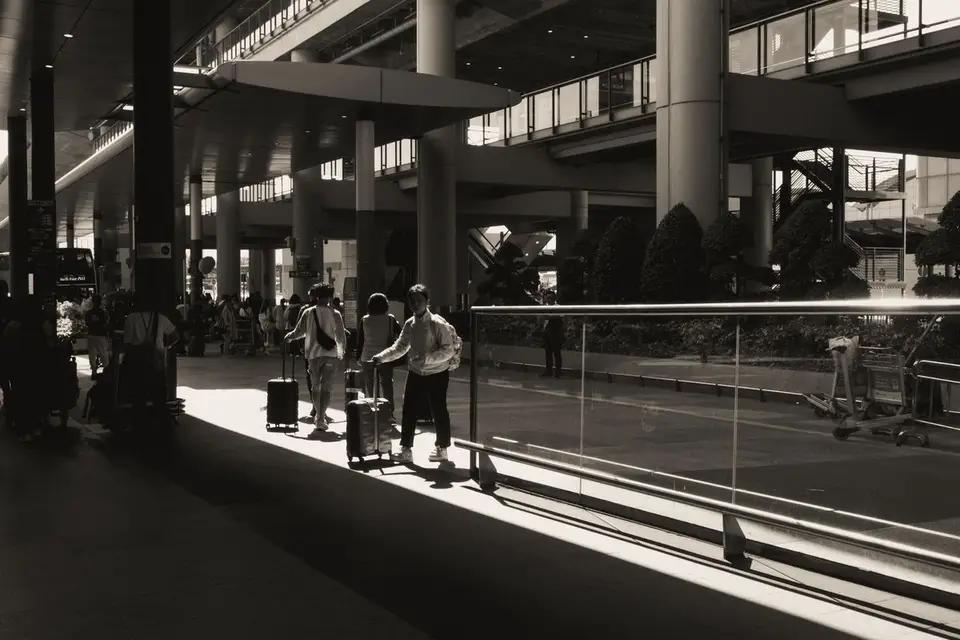
Ambouli international airport stands about seven kilometres from the city centre of Djibouti, roughly a ten-minute drive outside peak hours. There is no regular public shuttle: the transfer is made by taxi, for about 1,500 Djiboutian francs, the figure published by the National Tourism Agency, by private vehicle booked in advance, or by hire car. Bring cash and agree the price before getting in.
How do you reach the city centre from Ambouli airport?
Ambouli international airport, code JIB, serves Djibouti from the southern edge of the capital. About seven kilometres separate it from the city centre, roughly a ten-minute drive outside peak hours. It is not a distance that calls for complicated organisation: it is a distance that calls for a decision taken in advance.
| Solution | Reference price | Where to get it | For whom |
|---|---|---|---|
| Taxi at the airport exit | About 1,500 Fdj to the centre | On the spot, at the terminal exit | Most travellers, if the price is fixed before getting in |
| Private transfer booked in advance | On quotation: ask the hotel or the operator | Booked with your accommodation or an operator | Night arrivals, families, travellers with heavy luggage |
| Car hire | Hire rate, not published by the agencies | Hire desks inside the airport | Long stays, independent itineraries |
| Regular public shuttle | — | It does not exist | Nobody |
The point to remember is the last one. There is no regular public shuttle between Ambouli and the city centre of Djibouti. Many travellers arrive with the idea that an airport bus will be waiting for them: there is none. The real choice therefore lies between the taxi, the private transfer and car hire.
What is the price of a taxi from Djibouti airport?
The fares published by the National Tourism Agency (January 2021 grid) give two reference points, and two only:
| Ride | Reference fare | What is included |
|---|---|---|
| In town, per zone | From 600 Fdj | The journey between two districts of the capital |
| From Ambouli airport to the centre | About 1,500 Fdj | About seven kilometres, ten minutes outside peak hours |
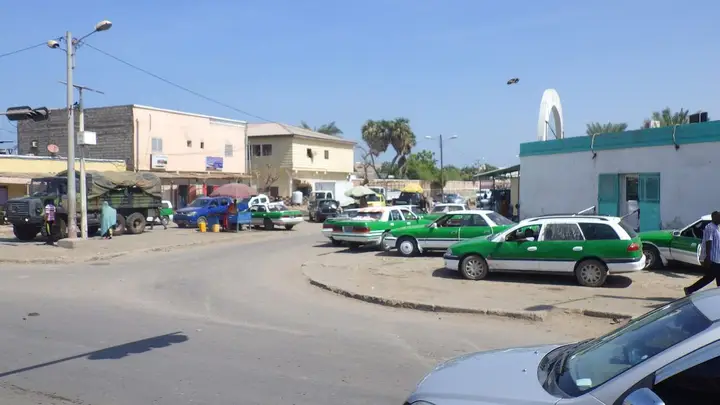
Those amounts are reference points, not prices displayed on a post: there is no meter. The fare is negotiated, and the final price depends on three simple variables — the exact destination, the time, and the number of bags.
Three practical consequences, which head off most of the unpleasant surprises.
Fix the price before getting in. That is the local norm. Once the vehicle is moving there is no more negotiation: only a disagreement.
State the exact destination, not the district. “The city centre” and “such hotel, such street” are not the same journey. Give the name of your accommodation: it is the most reliable landmark, and it avoids a billed detour.
Have the exact money in Djiboutian francs. The first journey is settled in cash. A high-denomination note, handed back approximately after a night flight, is an unnecessary source of tension.
How is the price of a taxi ride calculated?
Since there is no meter, the question “how is the price calculated” has a different answer from the expected one: the price is not calculated, it is agreed. The informal method rests on three factors that driver and passenger assess in the same way.
- The zone of departure and the zone of arrival. Djibouti City works by zones; a ride in town starts at about 600 Djiboutian francs per zone.
- The real distance and the journey time. The seven kilometres from the airport put the ride at about 1,500 Djiboutian francs. In peak hours, the same distance takes two to three times as long.
- The volume carried. Bulky luggage, diving gear, groups: anything that fills the boot is discussed before departure, never afterwards.
The golden rule fits in one sentence: a verbal agreement before departure is worth more than a dispute on arrival. If the quoted price seems excessive, offer your own: negotiation is normal and expected. If you speak neither French nor Arabic, show the written address and the amount on a phone; that is enough.
One clarification for long journeys: a city taxi is not suited to a trip into the interior of the country. For Arta, Lake Assal or Tadjourah you need a hire vehicle or an organised excursion — the distances are 42 kilometres to Arta, about 120 to Lake Assal, about 180 to Tadjourah.
What happens on arrival at Ambouli?
The airport has three useful services as soon as you leave the terminal: a bureau de change, an information desk and car hire desks. That is enough to settle the first hour, provided you have prepared the paperwork.
Entry formalities. If you applied for your e-Visa online, you present it on arrival, printed or on a phone — the official portal issues it as a PDF, and the page on visa and entry formalities details its three steps. A visa on arrival remains possible for many nationalities, paid in cash and in US dollars, but it means waiting at the counter.
Changing money. The airport bureau de change lets you obtain Djiboutian francs immediately. That is the moment to do it: camps and sites in the interior have neither a cash machine nor a card terminal.
Keeping your belongings safe. The official British advice reports a risk of petty crime and recommends keeping valuables, cameras and passports in particular, out of sight. That applies from the airport exit onwards: a passport and a phone do not stay on the back seat of a taxi.
Medical emergency. The official advice publishes two numbers to call for an ambulance: 21 35 09 62 or 21 35 27 12. Tell your insurer quickly if you are referred to a medical facility.
Can you book a private transfer in advance?
Yes, and it is the most comfortable solution for three specific profiles: a night arrival, a family trip with children, and a stay whose programme begins the following morning.
The mechanism is simple: you ask your accommodation whether it provides the transfer, or you go through a local operator, and you fix the rate before departure. We publish no private transfer price list, for a deliberate reason: those services are sold on quotation, and no official source publishes a reference price. A firm rate displayed here would be an invention — so always ask for a written quotation stating the number of passengers and bags.
| Your situation | Recommended solution | Why |
|---|---|---|
| Daytime arrival, a single bag | Taxi at the terminal exit | Simple, immediate, about 1,500 Fdj to the centre |
| Arrival after 22:00 | Private transfer booked in advance | A vehicle waiting for you by name, with no night-time negotiation |
| Family with children and luggage | Private transfer or hire vehicle | Space and seats confirmed before departure |
| Stay of several days with an itinerary | Car hire | The vehicle then serves the sites and the national roads |
| A single night in transit | Taxi, or a transfer included by the hotel | The cost of a hire is not justified for a few hours |
What budget should you plan for the transfers of your stay?
The arrival transfer is only one line of a wider budget, and it is useful to place it.
| Item | Documented reference | Source of the reference |
|---|---|---|
| Taxi in town, per zone | From 600 Fdj | Agency useful information — January 2021 grid |
| Airport to the city centre | About 1,500 Fdj | Agency useful information — January 2021 grid |
| 4×4 with driver, per day and per vehicle | About 44,000 Fdj | A commercial display, not a catalogue price: the “vehicle hire” type does not exist in the catalogue. To be confirmed by written quotation |
| Day trip to Lake Assal | About 18,000 Fdj per person | Catalogue offer, transport included |
| Ferry to Tadjourah, per adult | 700 Fdj (Tadjourah), 800 Fdj (Obock) | Agency useful information — January 2021 grid. Child aged 2 to 12 and student: 350 and 400 Fdj |
Two structural savings deserve a look before you book anything.
A 4×4 with a driver pays for itself from four people: about 44,000 Djiboutian francs divided by four drops below the per-person price of an organised excursion. Below three passengers, the opposite is true.
Included transfers change the equation. Many stays and excursions include transport from Djibouti City: that is one budget line that disappears, and one airport transfer less to negotiate. The detail of the packages is set out in transport in Djibouti.
To prepare what comes next, two further pages complete this one: how to get to Djibouti for the flight and the boarding formalities, and bus and taxis for getting around town without a car once you are settled.
Frequently asked questions
What is the price of a taxi in Djibouti?
Rides in town start at about 600 Djiboutian francs per zone, according to the fares published by the National Tourism Agency. The transfer from Ambouli international airport, about seven kilometres from the centre, comes to about 1,500 Djiboutian francs on the same grid. No meter is used: the price is fixed before you get in. Bring cash, as not all drivers accept bank cards.
How is the price of a taxi ride calculated?
The calculation rests not on a meter but on a negotiation by zone, held before getting into the vehicle. Three elements set the price: the destination district, the time of the ride and the volume of luggage. In Djibouti City, a ride in town starts at about 600 Djiboutian francs per zone. Agree the total amount, luggage included, and check that the quoted price really matches the exact destination.
Is there a shuttle between Ambouli airport and the city centre?
No. There is no regular public shuttle between Ambouli international airport and the city centre of Djibouti. The available solutions are therefore the taxi, negotiated on the spot, the private transfer booked in advance with a hotel or an operator, and car hire collected from a desk at the airport. Many hotels in the capital offer a transfer on request, to be confirmed at the time of booking.
How long does it take to reach the city centre from the airport?
Allow about ten minutes to cover the seven kilometres separating Ambouli airport from the city centre, outside peak hours. At the end of the day, traffic in Djibouti City is dense and undisciplined: plan instead for twenty to thirty minutes. If you are connecting to a journey into the interior of the country, add a margin before departure, especially for a return flight.
Can you pay for the transfer by bank card in Djibouti?
Not reliably. Taxis are paid in cash, in Djiboutian francs, and most drivers do not have a card terminal. Transfers booked in advance with a hotel or an operator are sometimes paid by card, but that is confirmed at the time of booking. Withdraw cash as soon as you arrive: the airport has a bureau de change, and cash machines are then concentrated in the capital.
Sources
Practical
Read next
4×4 with a driver in Djibouti: prices and itineraries
Accessibility in Djibouti: what a demanding trip implies
Boat hire in Djibouti: trips out to sea
Budget in Djibouti: what does a trip cost on the spot?
Buses and taxis in Djibouti: fares by zone and route
Car hire in Djibouti: 4×4, saloon or driver?
Connectivity and SIM cards in Djibouti: internet and mobile
Djibouti–Addis Ababa train: line, tickets and station