Camp or hotel in Djibouti: what do you gain?
Camp or hotel, in Djibouti, does not set comfort against lack of comfort. The two are compared on what they make you gain and what they make you lose. Our catalogue publishes a night under the stars at 8,000 Djiboutian francs, a seaside camping pitch at 10,000, a night on Ras Korali beach at 17,000 per adult, and hotel rooms from 18,512 to 91,492 francs.
Camp or hotel in Djibouti: what is the comparison really about?
The question is rarely put in those terms, and that is what makes it interesting. Nobody hesitates between a camp and a hotel for the same reasons as between two hotels: the comparison does not set good comfort against bad, it sets two different things you gain against two different things you give up.
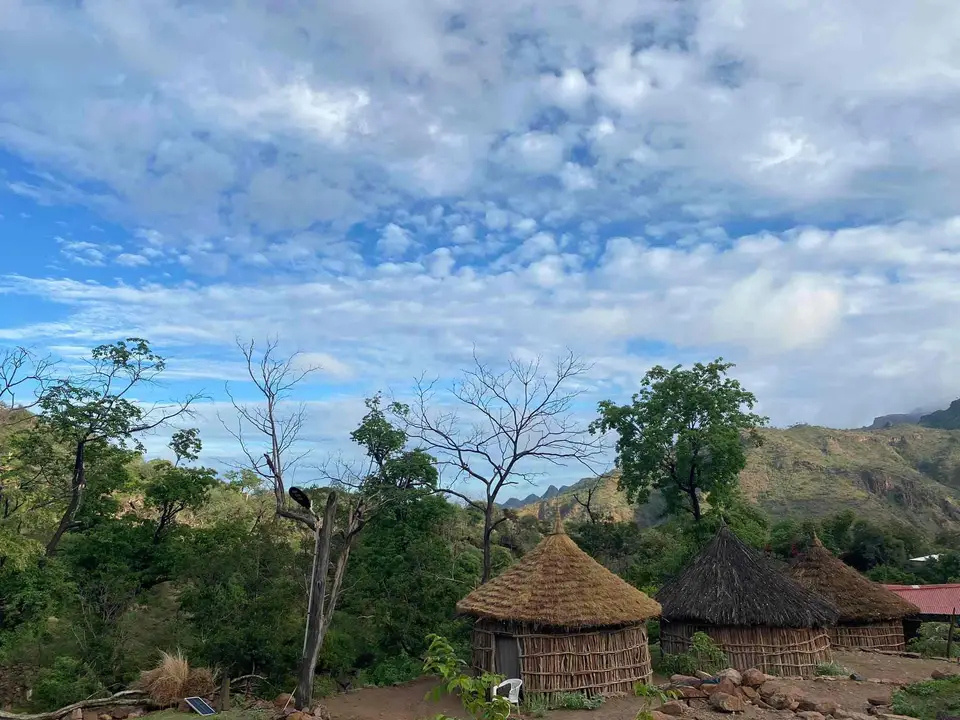
A Djiboutian camp occupies a place the hotel cannot take: the country’s natural sites are too far from Djibouti City for a day visit, and too fragile to host heavy infrastructure. Sleeping on the spot is therefore the only way to see certain sites other than between two journeys. This site’s camps and ecolodges folder details what a camp really is, region by region.
The hotel, for its part, wins on another ground: it can be booked online, it is in town, and it depends neither on the weather nor on the state of a track. That is not a lesser argument.
| Criterion | Camp | Hotel |
|---|---|---|
| Position | On the natural site, a walk from the trails or the beach | In town, at a distance from the sites |
| Booking | By telephone, small capacities | Online, larger capacity |
| Catalogue price | 8,000 to 17,000 Fdj depending on the formula | 18,512 to 91,492 Fdj in the capital |
| Uncertainty | Weather, track, access | None |
| What you come for | The site itself | A logistics base |
How much does a night in a camp cost, and how much in a hotel?
Here are the only nights our catalogue prices. Each amount is attached to its offer: we advance no price that does not come from the catalogue.
| Night formula | Where | Catalogue price (Fdj) |
|---|---|---|
| Night under the stars, village resort | Loubatanleh, Tadjourah region | 8,000 |
| Seaside camping pitch | Les Sables Blancs, Obock road | 10,000 |
| Full-board camping | Les Sables Blancs, Obock road | 15,000 for 1 person, 13,500 for 2, 12,000 for 3 to 5, 10,000 for 6 to 10 |
| Night on the beach | Khor Ambado | 15,000 per adult |
| Night on the beach | Ras Korali | 17,000 per adult, 12,000 per child aged 4 to 10 |
| Double room, entry level in town | Capital Hôtel, rue de Rome | 18,512 |
| Deluxe double room, airport axis | Golden Airport, route de l’Aviation | 21,360 |
| Suite, high end in town | Escale International, rue de Venise | 91,492 |
Two lessons come out of that table.
The camp is cheaper, but not by an order of magnitude. The gap between the cheapest camp night in the catalogue (8,000 Djiboutian francs at Loubatanleh) and the cheapest hotel room in the capital (18,512 francs at the Capital Hôtel) is real, but it narrows as the camp’s comfort rises: a night on Ras Korali beach, at 17,000 francs per adult, is level with the bottom of the hotel range.
The camp becomes frankly cheap in a group. The full board at Les Sables Blancs goes from 15,000 francs for one person to 10,000 per person in a group of six to ten. The logic is constant on that coast: the dominant cost is not the room, it is transport and logistics.
A point of honesty, because it qualifies the reading: the cheapest night in our whole catalogue is neither a camp nor a city room, but a bungalow at the Sinny Hill Center in Arta, at 7,800 Djiboutian francs. It is not a camp, nor is it a capital hotel, and it reminds us that neither of the two columns above is an absolute floor.
Why do the nine camps have no published price?
It is the most visible gap in this comparison, and it has to be explained rather than filled with an estimate.
The nine camps recorded — Dittilou, Djalelo, Assamo, Dhaydhan, La Maison des Randonneurs, Rayali chez Fato, Ras-Bir Houguef, the Village de la Mer Rouge and Seven Brothers — have no priced night in our catalogue. It is not an editorial oversight: the catalogue publishes five nights in a camp or by the sea, and none corresponds to those nine sites. They are at Les Sables Blancs, Khor Ambado, Ras Korali and Loubatanleh.
Only one of the nine appears in the catalogue, Assamo, and in another form: a group package at 26,691 Djiboutian francs, that is a stay, not a room rate. The difference is not cosmetic: it means the price of a night at Dittilou or Ras-Bir Houguef appears in none of our sources. The price is set by the camp, and it is asked of the camp directly.
We do not copy a rate found elsewhere to fill the gap. That would be exactly the flaw we criticise in competing pages: a figure that looks like a price and commits nobody.
What do you gain in a camp, and what do you give up?
It is the table that decides, more than the price gap.
| What the camp makes you gain | What you have to give up |
|---|---|
| Being on the site: trails or beach on foot, no morning journey | A standardised, air-conditioned room |
| Silence and the night sky, with no city light | Private bathrooms: they are often shared |
| A real immersion, and meeting the guides and inhabitants | Guaranteed electricity: it is sometimes solar, sometimes cut |
| Access to sites too remote for a day visit | Guaranteed running water at several beach camps |
| A price that decreases with the size of the group | Card payment, rare or even impossible outside Djibouti City |
| Food cooked on the spot | Simple booking: it is done by telephone |
That table is not a reformulation of impressions: the equipment elements in it are those already described on the camps and ecolodges page, which lists them site by site. What our catalogue does not document, on the other hand, is air conditioning, Wi-Fi or breakfast at the camps: that information is asked for at the time of booking.
One practical point deserves adding, because it weighs more heavily than comfort: you need a fallback plan. In the event of strong wind or a cut track, a beach camp can become inaccessible. That is an uncertainty a city hotel does not know.
What do the Google ratings of the camps and hotels say?
Five of the nine camps are rated, four are not at all. Here they are, with their number of reviews and the date of the record, as they should be.
| Camp | Region | Google rating | Reviews | Record |
|---|---|---|---|---|
| La Maison des Randonneurs | Arta | 4.8/5 | 18 | September 2026 |
| Ras-Bir Houguef | Obock | 4.4/5 | 21 | September 2026 |
| Dittilou | Tadjourah | 4.4/5 | 10 | September 2026 |
| Dhaydhan | Ali-Sabieh | 4.3/5 | 10 | September 2026 |
| Village de la Mer Rouge | Obock | 3.9/5 | 19 | September 2026 |
And the hotels in our catalogue, to place those ratings:
| Hotel | Google rating | Reviews | Record |
|---|---|---|---|
| Golden Airport Hôtel, route de l’Aviation | 4.4/5 | 52 | September 2026 |
| Escale International Hôtel, rue de Venise | 4.3/5 | 59 | September 2026 |
| Capital Hôtel, rue de Rome | not rated in our record | — | September 2026 |
The fact to look in the face is this one: the Village de la Mer Rouge, at 3.9/5 from 19 reviews, is rated lower than the two capital hotels we sell, even though it is also a seaside camp on a fine sand beach. We report it as it stands. A camp rated lower than a hotel is not an anomaly to explain, it is useful information: the camp is not automatically the best choice because it is the most change-of-scenery.
Two reservations of method, which cut both ways. The number of reviews remains modest everywhere: from 10 or 19 reviews, a few stays are enough to move the average, and none of those ratings has the solidity of a hotel rated from several hundred reviews. And four camps — Djalelo, Assamo, Rayali chez Fato and Seven Brothers — have no Google rating in our record: we do not know how they are appreciated, and we do not assume it. The detail of the Obock camps is on the page where to stay in Obock, and that of the Village de la Mer Rouge on its dedicated page.
How do you combine a camp and a hotel in one stay?
The right answer is almost never one or the other. On a stay of five to seven nights, the combination that works best is also the simplest:
- Two nights in a hotel on arrival, time to recover from the flight and find your bearings in the capital. The choice of district matters here more than the category of the establishment: see which district to stay in in Djibouti City.
- One to two nights in a camp in the middle of the stay, on full board if you want to manage nothing on the spot.
- A night in a hotel before departure, especially if the flight leaves early.
Three calendar rules, which follow from the sector’s constraints. Book the camp at least two weeks in advance, and a month for a group or for the end-of-year holidays: capacities are counted in tens of people, not hundreds. Concentrate the camp on October to April: in summer, the heat makes the bivouac uncomfortable on the coast. And if your itinerary depends on a track, first see with or without a driver: an inaccessible camp is not worth the night booked there.
To go further on a specific site, the page for La Maison des Randonneurs, rated 4.8/5 from 18 reviews, details accommodation in Arta, the camp easiest to fit into a short stay.
Frequently asked questions
Which costs less, a camp or a hotel in Djibouti?
For the nights our catalogue prices, the camp stays ahead. The night under the stars at Loubatanleh is 8,000 Djiboutian francs, the seaside camping pitch at Les Sables Blancs 10,000, against 18,512 francs for the cheapest double room in the capital, at the Capital Hôtel. The gap narrows if you travel alone and a hotel room costs you the same.
Why do the nine camps in Djibouti have no published price?
Because our catalogue publishes no priced night for them. It offers five nights in a camp or by the sea, and none corresponds to the nine camps recorded, from Dittilou to Ras-Bir Houguef. Only one appears, Assamo, as a group package. We do not copy a rate found elsewhere: those prices must be asked of the camp directly.
Is a camp rated lower than a hotel in Djibouti?
Sometimes, yes, and it is a fact to report as it stands. The Village de la Mer Rouge, at Obock, is rated 3.9/5 from 19 Google reviews, recorded in September 2026, when the Escale International Hôtel reaches 4.3/5 from 59 reviews and the Golden Airport 4.4/5 from 52 reviews. A camp can therefore be rated lower than a hotel, including a cheaper one.
How many nights should you spend in a camp in Djibouti?
One to two nights, in the middle of the stay, not on arrival or departure. Capacities are small, between twenty-eight and thirty people for the largest ecotourism camps, and the cool season concentrates local demand at weekends. Allow two nights in a hotel on arrival and departure, and one or two nights on the natural site in between.
What should you check before booking a camp?
Three points, in this order. What is included: meals, transfer, sheets, mosquito net, drinks — the first source of a gap between the announced price and the bill. Access: some sites lie at the end of a track that can be cut. Capacity: several camps have fewer than ten rooms, and a December weekend can fill them.
Sources
Comparisons
Read next
Car hire companies in Djibouti: eight agencies, no ranking
Dive centres in Djibouti: two operators, not ten
Lake Assal or Lake Abbé: two salt deserts, two budgets
Moucha or Maskali: two islands, one trip?
Which neighbourhood to stay in Djibouti City?
Which season for the whale shark in Djibouti?
With or without a driver in Djibouti: deciding